Saturday, July 19, 2014

Satsukiyama Zoo


Satsukiyama Zoo in Ikeda City, Osaka Prefecture, can best be described as a “small” and “cute” zoo.  First the “small”: the land area of the zoo covers only 0.3 hectares (3000 square meters).  You can walk the length of the zoo from end to end in less than 5 minutes.  Second, the “cute”: the zoo specializes in herbivorous animals that are adorable and popular among children.  They have wombats, wallabies, emus, sheep, goats, alpacas, pigs, rabbits, guinea pigs, turtles, chickens, a Patagonian cavy, and a raccoon.  Admission to Satsukiyama zoo is free.

The general design of the zoo features simple fences surrounding open areas of earth.  You can get rather close to the animals, but the fences are an obstruction when trying to take photographs.


From Tasmania With Love
Ikeda City, the owner of Satsukiyama, has a sister city relationship with the Australian municipality of Launceston, Tasmania.  It is that relationship which gives this collection its definite Australian flavor.  In 1967, to commemorate the sister-city relationship, Launceston gave Ikeda some Bennett’s wallabies.  To celebrate the 25th anniversary of the relationship in 1990, Launceston sent 3 wombats.  Without question, the wombats are the stars of this zoo.  Their enclosures are the largest and are additionally surrounded by a guard railing to keep a protective distance between visitors and the fence.  They are also monitored by video that is streamed 24 hours a day on the internet. 

The photo below shows Wandar (female), a Naked-nosed Wombat (Vombatus Ursinus).  According to the IUCN’s red list of threatened species, a 2008 assessment rated the threat to this particular species of wombat as being of “least concern”, stating that this type of wombat was common and that the population trend of this animal was stable. 


This is Waine (male).


Bennett’s wallaby (Macropus rufogriseus).  A 2008 IUCN assessment also rates the threat to this animal as being of “least concern”.


Wallaby enclosure.  Given the relatively small size of the wallabies, this exhibit seemed to be fairly large, with enough space for them to hop back and forth over an open ground.


The Town Mascot
In the shopping arcade located nearest the zoo, I couldn’t find any directional signs leading to the zoo.  I did, however, find a number of wombat statues and signs featuring a wombat character. The wombat appears to have become the mascot of Ikeda City.

Shopping arcade


 Arcade sign


Statuette on a bench


Statuettes on a postal drop box


Farm Animals
Besides the wombats and wallabies, most of the other animals at this zoo are of the domesticated type (sheep, goats, alpacas, pigs, rabbits) that you would normally expect to find on a farm.  Much like on a farm, although the enclosures for these animals were not that big, the animals did not show any particular signs of distress or discomfort. 


Alpaca (Vicugna pacos) enclosure


Emu (Dromaius novaehollandiae)


Goats 
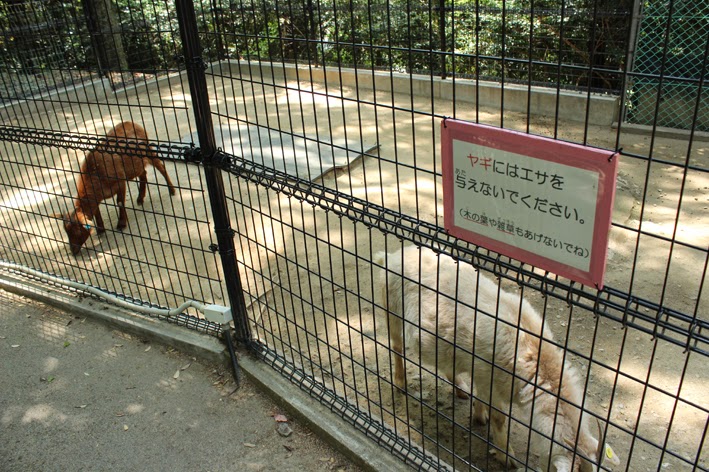

Sheep (Ovis aries)


Patagonian Cavy (Dolichotis patagonum)


Educational Efforts
Despite its small size, this zoo had a substantial educational room that included information regarding wombats as well as birds and small animals native to Japan.  Most interestingly, some of the wombats who lived at this zoo were preserved in the form of taxidermy specimens, skeletons, or pelts.  For the student of zoology, this is certainly very educational.  For visitors who loved the wombats when they were alive, it might be a bit morbid.  Unfortunately, the information in this room was only written in Japanese.  


This exhibit had a lot of information about wombats, including photos of each of the wombats who lived at Satsukiyama.


The display on the opposite wall includes taxidermy specimens of small mammals, birds, and insects native to Japan.


The below skeleton on the left is “Satsuki”, a female that passed away at the age of 19 years old.  The taxidermy specimen on the right is “Ayaha”, a female that lived until she was 5 years old. 


This framed set of bones is “Teia”, a female that died at 14 years old.


The pelt in the case below belonged to “Satsuki”, the 19-year old.  Apparently her bones and pelt were separated.  The hole in the middle of the Plexiglas case allows visitors to touch the pelt and experience the texture of wombat fur.  To the right of the case is a shipping crate that was presumably used to bring the wombats to Ikeda City.  A label on the wooden crate reads “Dreamworld, Gold Coast, Australia”.  


The Convict
The animals in this collection seemed to be in good condition.  The one possible exception might be the raccoon.  I don’t think that Japanese people particularly dislike raccoons (in fact a 1970’s anime featuring raccoons was very popular), but I do think that raccoons have an image problem.  Perhaps it is because they raid farmers’ fruit orchards and vegetable gardens and are considered serious agricultural pests.  Perhaps it is because they have been designated by the Japanese government as a harmful invasive species, and are therefore considered unwanted illegal aliens.  Perhaps it is because they have masked faces and look like bandits that belong in a jail.  At a number of zoos that I have visited in Japan, the raccoon enclosures have somehow reminded me of jail cells, with minimal features and only concrete floors. 

This particular raccoon had the smallest enclosure in this zoo.


The raccoon had bald patches on its back which appeared to be the result of biting itself.  I don’t know if this was a temporary state or the animal’s usual condition.  I also don’t know whether this was the result of fleas or stress. Whatever the cause, it was sad to see.


Opportunities for Animal Encounters
There was an area where visitors (mostly children) could touch rabbits, guinea pigs, turtles, and chickens during the time periods from 11:00 to 12:30 and from 13:40 to 15:00.


Besides this special area, almost all of the other enclosures (except for the wombat and raccoon enclosures) seemed designed to allow visitors to feed the animals.  Posted signs asked that visitors only give the animals food sold by the zoo, and coin-operated dispensers located throughout the zoo had feed pellets available for 100 yen.  Although separated by a fence or railing, visitors could have direct contact with the wallabies, goats, sheep, alpacas, and emus.


Food and Souvenirs
There was a park information house (below photo) with a small store near the zoo entrance that sold foods such as takoyaki and ice cream.  They also sold small stuffed animals.  The only products with the Satsukiyama Zoo name and logo were postcards and plastic file folders.


 Getting There


The nearest train station is the Hankyu Ikeda-shi station.  At the station, there were no visible signs or billboards specifically advertising the zoo, and no directional aids leading to the zoo.  Visitors should prepare themselves with a map and perhaps a smart phone equipped with a GPS application.  From the station, it is about a 1-kilometer walk up a gentle slope to the Satsukiyama Park that should take 15 to 20 minutes.  The zoo occupies a small part of the larger park, and it could be easily bypassed if you miss the landmarks (see above photos of the park information house and of the green zoo gate).  If you like wallabies, wombats, and going for walks, this zoo may well be worth your time.  Since admission is free, the only thing you risk is your time.

(Note: All photos taken in this post were taken during a visit on May 6, 2013.  The comments in this post are based on observations made on that day.  Conditions may have since changed.  Please check it out for yourself!)


Saturday, July 12, 2014

Yagiyama Zoological Park


The last weekend in April was a good time to visit Yagiyama Zoo in Sendai, Miyagi Prefecture. The last of the cherry blossoms were still falling from the sakura trees, and every time a gust of wind blew, a new flurry of pink petals would begin a slow, twirling descent to the ground.  Walking around the zoo in the middle of these small flurries, I felt like I was being showered with light pink confetti.  The zoo is spread out over about 14 hectares on two levels of a small mountain, and the grounds are surrounded by a lot of trees.  It seems like a very popular place to take the family for a weekend picnic on a nice sunny spring day, and indeed, on the day I visited, the zoo was full of families with young children (some quite noisy). 

The Hawai’i Connection
One of the reasons I wanted to visit Yagiyama was to see “Keahi”, a Sumatran tiger (Panthera tigris sumatrae) that was born at the Honolulu Zoo in 2008, and his cubs.  Keahi was sent to Yagiyama in 2011, and he has already managed to father two sets of cubs there, with the second set of four cubs being born on 21 May 2013.  Since there are probably less than 500 Sumatran tigers left in the wild, Keahi’s achievements have great meaning for conservation efforts.


During the afternoon, Keahi had the main exhibit area to himself.  In the Hawai’ian language, “Keahi” means “fire”.  Shortly after I visited Yagiyama, it was announced that Keahi would be sent to Ueno Zoo in Tokyo, presumably to produce offspring there as well. 

This is the west side of the tiger enclosure.  There is a waterfall, a small running stream, and a fair-sized pool in which the tigers can cool-off.  The west part of this installation looks to be secured by an electrified fence that keeps the big cats from climbing out.


This is the south side of the enclosure.  The inside of the exhibit is full of plants and rock features that suggest more tropical environs.  I’d like to someday see what this exhibit looks like in the Miyagi winter when the snow piles up on the ground.


Here is one of Keahi’s sons.


The names of the two male offspring are “Akala”, whose name means “sun” in Hawai’ian and “Bulan”, whose name is Indonesian for “Moon”. During the morning, the two male cubs were displayed in the main part of the tiger exhibit, and the two female cubs were displayed in a smaller part of the exhibit which was separated from the main area by a temporary-looking fence made of plastic and wood.  (Incidentally, on 11 June 2014, Bulan was moved to the Misaki Zoo in Osaka.)

This is the east side of the exhibit, the smaller part where the two female cubs were kept.  The names of the females are “Aina”, which means “Earth” in Hawai’ian, and “Laut”, which means “Ocean” in Indonesian.


One of the sisters.


A video of the Keahi family enclosure:


There were many easy-to-understand explanatory signs in this zoo (assuming you can read Japanese).  There seemed to be many signs near the enclosures of the larger, more popular animals, and fewer, minimal signs near the enclosures of the smaller animals.


This is the lion exhibit.  Unlike the tiger exhibit which had a lot of vegetation, the lion exhibit was like a large, wide-open grass lawn.  At least it looked large enough for the lions to freely tumble around.


African Area
The African area, which occupies more than half of the upper part of the zoo property, featured large, wide-open enclosures for the elephants, giraffes, rhinoceros, zebras, ostriches, and hippopotamus.  It seemed like the animals had a fair amount of room to themselves, and the vantage points where visitors stood to view the animals seemed to be kept at a respectful distance. 


Look at the cute couple below.  They seemed to be flirting with each other. Is that really a smile?  Or am I simply attributing human emotions onto these African elephants (Loxodonta africana)?


Reticulated giraffe (Giraffa camelopardalis reticulata). 


That’s the rear end of a hippopotamus (Hippopotamus amphibius) near the artificial rock ledge.


Other Animals and Exhibits
Bactrian camels (Camelus bactrianus).  (I’ve always wondered what it feels like to ride between those two humps.)


Red Panda (Ailurus fulgens)


Japanese macaques (Macaca fuscata)


Black-tailed Prairie Dog (Cynomys ludovicianus).


Interior of reptile house.


The Cages
Zoos are sometimes criticized regarding the size and design of certain exhibits.  Enclosures for raptors might be criticized as being too small for a bird that in nature might fly very far (and sometimes very fast).  Other displays might be described as being stereotypical “cages”, with no place for an animal to retreat from the loud and noisy human visitors.  I think each exhibit needs to be judged on its own merits.  Below are a few exhibits that might draw comments from visitors. 

Black Kite (Milvus migrans).


Common raccoon (Procyon lotor).


Guinea baboon (Papio papio).


American beaver (Castor canadensis).


Opportunities for Animal Encounters
Near the south entrance to the zoo, there was a rabbit house.  A sign indicated that there was a 30-minute period when visitors could feed the rabbits, and according to the zoo guidebook, a cup of rabbit food costs 100 yen.


There is also a separate 30-minute period when visitors can touch the guinea pigs, and the guidebook says that this activity is limited to Saturdays, Sundays, and Holidays during the period from April to November.  Because I was too late to watch the rabbit feeding, and too early to witness the guinea pig touching, I was unable to observe how many visitors participated in this activity.


Food and Souvenirs
There were about four food concessions in Yagiyama at the time of my visit as well as a lot of what appeared to be temporary booths set up for the busy cherry blossom season.  They seemed to have the usual Japanese “B-class gourmet” and favorites such as curry rice, udon, frankfurters, French fries, etc.


Because I had only a limited amount of time at the zoo before going to Sendai Airport, I skipped lunch and just had a small bowl of “kakikori” (shaved ice).


This was the souvenir shop just inside of the main gate.  It had the usual assortment of animal toys, keychains, etc.


Getting There


According to information found in magazines and on the internet, buses from Sendai station to the zoo take about 20 minutes and cost 250 yen.  Because of my large backpack, I decided to take a taxi, and it ended up costing me almost 2000 yen each way.  Many of the roads were quite narrow, and in moderate traffic it took about 20 minutes to reach the zoo.  The taxi driver said that, on days when traffic is bad, it takes even longer, so I suspect that the bus ride estimate of 20 minutes may be a little short.  When I left the zoo, I found a taxi waiting area about 50 meters from the zoo’s front gate, so catching a ride back to Sendai station was easy, but not cheap.  Adult admission was 400 yen.  Admission for intermediate and elementary school children was 100 yen.  Children not yet in school get in free.

(Note: All photos in this post were taken during a visit on April 26, 2014.  The comments in this post are based on observations made on that day.  Conditions may have since changed.  Please check it out for yourself!)