For
the second year in a row, I celebrated New Year’s Day at Tennoji Zoo in Osaka. In late 2014, the zoo announced that it would
open on January 1, 2015 in observation of its 100th anniversary. Apparently, the event must have been successful,
because they decided to stage a repeat on January 1, 2016. (In past years, the
zoo was closed from December 29th to January 1st in
observance of the New Year’s holiday.)
This
year, the decorations at the Shinsekai entrance included greetings in a number
of different languages - an apparent recognition of the fact that the number of
foreign tourists visiting Japan has greatly increased in recent years. Walking around the zoo, my impression was
that there were fewer special events than last year, but there seemed to be
more visitors this year. One event that
was repeated was the give-away of free commemorative calendars to the first
1000 visitors through the gate.
One year ago, one of the crowd
stoppers was the pair of young Jaguars (Panthera onca) that were born August 9,
2014. Last New Year’s Day, they were still
very small and very cute.
One
year later, they were almost as large as their mother, and the female cub was even
moved into a separate exhibit space next door.
(I think there was a leopard in that space last year.)
The
larger size of the growing cubs made the small size of their enclosures even more
obvious.
This year, another crowd
pleaser was the rock hyraxes. There were
five of them, and they were actively eating.
The last time I visited Tennoji Zoo in August, I only noticed two
hyraxes, and they were sleeping.
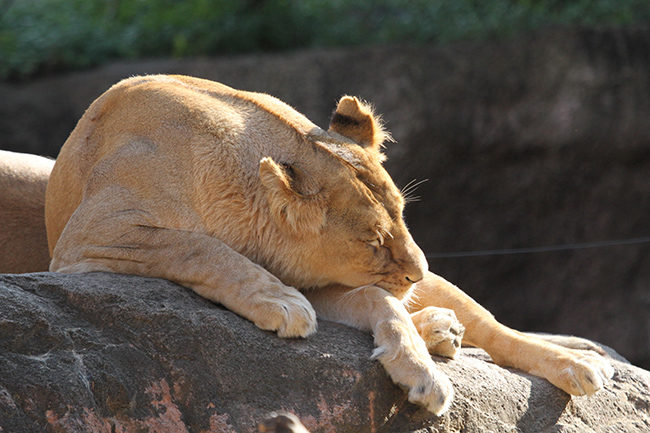
The
lions next door also attracted a crowd.
Very
majestic…
Another
change since last year involved the tigers.
The female tiger Ayako passed away last July 5 at the age of 18 years (quite
an advanced age for a tiger). The very next
day, her partner Senichi (12 years old) was moved from the old tiger enclosure
to the new tiger enclosure. Now the two
males, Senichi and Kojiro are displayed in rotation in the new tiger
enclosure. Last New Year’s Day, Kojiro
was on display in the new enclosure while Senichi and Ayako were still in the
old enclosure. This year, Senichi
enjoyed the run of the new enclosure. Somehow, I think he looked more natural
in the old place. The old tiger enclosure had more greenery. In the new tiger enclosure, the concrete walls
dominate the scene a little too much.
Senichi
close-up
On
this day, the younger tiger Kojiro, was confined to the small indoor exhibit. He seemed to be quite relaxed.
I
wonder if the zoo will be open for New Year’s Day 2017. If it is, I think I will make this visit a
yearly tradition.
(Note:
All photos taken in this post were taken during a visit on January 1, 2016. The comments in this post are based on
observations made on that day.
Conditions may have since changed.
Please check it out for yourself!)
New
Year’s Day might be an unusual day to go to a zoo, but since Tennoji Zoo in Osaka announced it would be
open on January 1st to start the celebrations of its 100th
anniversary, I thought I would go to see how the animals greeted the start of
2015. (In usual years, the zoo is closed
from December 29th to January 1st in observance of the
New Year’s holiday.)
Predictably,
there were congratulatory decorations, signs, banners, and a few commemorative
goods for sale. There were also a number
of special events, and even free commemorative calendars for the first 1000
visitors through the gate.
Despite the very cold
temperature, there were a surprising good number of visitors in the zoo. One of the crowd stoppers was the pair of
young Jaguars (Panthera onca) that were born last August 9th.
The
window of the exhibit was a bit dirty, so it was impossible to get a sharply
focused photograph of the baby Jaguars.
Even
if the photo isn’t sharp, they’re still very cute.
If
only the exhibit was larger… and nicer… and had more natural elements…
Perhaps
the biggest crowd of the day was the approximately 150 people gathered to watch
ten visitors play a game of “tug-of-war” against Kojiro, the young male Amur tiger
(Panthera tigris altaica).
They
tied one end of the rope to a large bone that still had some meat on it.
When
Kojiro grabbed the bone, the participants pulled on the rope - not with all
their might, but with just enough resistance to give Kojiro some exercise.
There
were a lot of video cameramen and photographers. I think they were from the television
stations and newspapers. At least two of
the video cameramen had armbands with the “NHK” television logo on it.
After
about 10 minutes, Kojiro was allowed to enjoy his afternoon snack.
(Note:
All photos taken in this post were taken during a visit on January 1,
2015. The comments in this post are
based on observations made on that day.
Conditions may have since changed.
Please check it out for yourself!)
Tennoji
Zoo, located in the southern part of OsakaCity, is like an island
of green in an ocean of gray concrete and black asphalt. For that reason, even in the middle of the
zoo grounds, you are often reminded of the surrounding buildings, and you can sometimes
hear the sounds of traffic on the highway bordering the western perimeter of
the zoo or the JR trains to the south. But
despite the background urban noise, Tennoji has enough green areas that Osaka citizens can make a
short escape from the “concrete jungle” and relax. Tennoji is also a good place to practice
animal photography because a number of the exhibits allow for clear views of
the animals, with no obstructions between camera lens and the subject.
(Photo:
January 2014)
Tennoji
zoo opened in 1915, and is recognized as the third oldest zoo in Japan (after Ueno in Tokyo and Kyoto Municipal). Not surprisingly, some parts of the zoo have
an older and out-of-date look and feel, and sometimes receive sharp criticism
on word-of-mouth internet web sites, especially from visitors from other
countries. The land area of Tennoji zoo
is only about 11 hectares, so visitors who usually visit zoos that have large
spacious enclosures are often disappointed by what they find at Tennoji. Owned
and operated by the City of Osaka, adult admission to the zoo is only 500 yen,
and improvements and updates to the zoo appear to be constrained by the whims of
city hall’s annual budgets.Despite its
shortcomings, Tennoji Zoo has a number of good exhibits and rest areas that are
well worth a look.
Enter the Jungle
There
are a number of landscape immersion design-type exhibits at Tennoji which
attempt to recreate the animals’ natural habitats. The best of these are the Asian Tropical Rainforest
area, the African Savanna area, the Bird Paradise aviary, and the IFAR reptile
house. The display methods and decorative
props in these areas really succeed in creating an engaging atmosphere.
Asian Tropical
Rainforest Area
There
are multiple entrances to this exhibit, and to get the full effect of the
designed environment, it is best to enter from the opening closest to the
monkey enclosures.
(Photo:
November 2013)
First,
you take a walk through the jungle.
(Photo:
January 2012)
Decorative
signs written in Thai language add to the Southeast Asian atmosphere.
(Photo:
November 2013)
This
tree stump is a man-made replica!
(Photo:
November 2013)
This
fake snake and fake bee hive are quite convincing. I’ve seen a number of startled visitors.
(Photo: November 2013)
(Photo:
November 2013)
A
replicated village elephant watch station complete with warning gong.
(Photo: November 2013)
(Photo:
January 2012)
Asian
elephant (Elephas maximus) “Haruko”, was born in Thailand in 1948 and came to
Tennoji in 1950. Advanced in age, she
has cataracts in her right eye and other physical characteristics appropriate
to a grand old lady. The other Asian
elephant, “Rani Hiroko”, was born in India in 1969 and came to Tennoji in 1970. In the photo below, Haruko is in the
foreground, Rani Hiroko in the background.
(Photo:
November 2013)
African Savanna: “Nzabi
National Park in Tennoji”
This
part of the zoo features landscape immersion type enclosures that recreate an African
savanna. This area hosts many of the
larger animals and larger exhibits, and for many people, this is the most
attractive zone in the zoo.
(Photo:
January 2010)
Hippopotamus
(Hippopotamus amphibious) exhibit
(Photo:
January 2011)
You
can also see the hippos underwater.
(Photo:
January 2012)
Black
Rhinoceros (Diceros bicornis) exhibit
(Photo:
April 2013)
(Photo:
April 2013)
The mixed
species exhibit includes Grant’s zebras (Equus burchelli bohmi), a Common eland
(Taurotragus oryx), Reticulated giraffes (Giraffa camelopardalis reticulate),
and various birds.
(Photo:
January 2010)
(Photo:
January 2010)
Lion
enclosure
(Photo:
January 2010)
(Photo:
January 2014)
Up
close with a lion (Panthera leo).
(Photo:
November 2013)
The
African Savanna area includes many well-done bilingual explanation signs
(Japanese and English). Visitors from
outside of Japan
often complain that many of the older parts of the zoo do not have enough
English signage.
(Photo:
April 2013)
(Photo:
April 2013)
(Photo:
April 2013)
Sometimes,
the restraining wires get in the way of a good photo.
(Photo:
January 2010)
Free Fly Zone: Bird
Paradise Aviary
The
Bird Paradise aviary at Tennoji is the largest that I have seen in Japan. It is probably close to 100 meters long, and
probably about 40 meters tall. (Caution:
I am not very good at visually calculating measurements.)
(Photo:
June 2014)
These
photos show the exhibit in mid-summer.
Everything is green and lush.
(Photo:
June 2014)
The
enclosure is very large, and birds can fly very naturally. See the video below:
There
are many birds that nest in this exhibit.
Perhaps that is an indication that the environment in this exhibit closely
approximates natural conditions.
European
White Stork (Ciconia ciconia) (Photo: June 2014)
Little
Egret (Egretta garzetta) (Photo: June 2014)
Even
birds that live outside of this enclosure seem to want to come inside.
(Photo:
June 2014)
A
waterfall.
(Photo:
June 2014)
Spotbilled
Duck (Anas poecilorhyncha) (Photo: June 2014)
Little
Egret (Egretta garzetta) (Photo: June 2014)
Black-crowned
Night Heron (Nycticorax nycticorax) (Photo: June 2014)
Live
fish for lunch!
(Photo:
January 2010)
The
middle of winter is not the best time to visit the aviary. Most of the trees are bare of leaves, and the
bird guano seems to be everywhere. I
find it better to visit in the summer when the vegetation is green and lush. Another good time to go is in the spring when
the cherry blossoms are in bloom.
(Photo:
January 2010)
(Photo:
June 2014)
(Photo:
March 2013)
IFAR Reptile House
The
IFAR Reptile house is home to various snakes, frogs, alligators, salamanders,
fish and even a couple of birds.
Entering the facility, you get the illusion that you are going
underground.
(Photo:
April 2013)
The
tree in the right foreground is man-made.
The environmental controls in this area are set to maintain a humid
climate, and every few minutes, a fine mist was sprayed from the ceiling.
(Photo:
June 2014)
Chinese
alligator (Alligator sinensis) (Photo: June 2014)
This
area recreates the surroundings of a Japan mountain stream. They even have a Japanese Giant salamander.
(Photo:
June 2014)
Opportunities for Animal
Encounters
At
the “Hitsuji Hiroba”, the area for domesticated farm animals, a visitor can buy
a small dish of pellets to hand feed the goats and sheep. The pellets cost 100 yen for a small dish,
and the zoo apparently puts a limit on how much feed is allowed per day because
if you arrive around noon, they are usually already sold out.
(Photo:
January 2010)
Food and Souvenirs
Tennoji
Zoo has a number of concessions with food and drinks. The offerings available include what the
Japanese call “B-class gourmet” items such as curry and rice, takoyaki, ramen,
fried noodles, and other “Japanese fast food”.
The food concessions are each paired with souvenir shops where visitors
can buy plush toy animals, keychains, books, toys, cookies, etc. The concessions are operated by vendors who
are chosen through a city bidding process. Perhaps that is the reason there is some variation
between the concessions regarding the quality of food offerings and souvenir
goods.
(Photo:
January 2012)
(Photo:
November 2013)
Getting There
It
is very easy to get to Tennoji Zoo. It
is about a 5 minute walk to the Shinsekai Gate from the Sakaisuji Subway line
Doubutsuenmae Station, the Sakaisuji Subway line Ebisucho Station, or the Midosuji
Subway line Doubutsuenmae Station. It is
also a 5 minute walk from the JR Tennoji Station to the Tennoji Gate. Depending on which entrance you choose, you
get a different first impression of the zoo.
The approach through Shinsekai takes you through a bustling commercial
area full of Kushikatsu restaurants and bars.
(Photo:
June 2014)
From
the Shinsekai area, you walk under a highway to reach the gate. For the first time visitor, this can create a
first impression that is unnecessarily drab and gray.
(Photo:
January 2010)
The
approach through the Tennoji Gate takes you through part of the botanical
garden. The surroundings are much
brighter and cheerful.
(Photo:
April 2013)
(Photo:
April 2013)
(Photo:
April 2013)
Last
of all, below is a video about some of the cute residents of the zoo: