In
September 2012, I had the opportunity to visit Seoul Zoo which is located at the
border of the Seoul and Gwacheon Districts in
the Republic of Korea.
Since I was preoccupied with chaperoning a group of students, and
because we did not allot enough time to adequately explore what turned out to
be a very expansive zoo, I didn’t take as many photographs of the animals as I normally
would.
A Really “Grand” Park
Seoul Zoo is located within
the SeoulGrandPark.
To get there, you ride the subway 11 stops from Seoul Station (about 20 to 25
minutes) to “SeoulGrandPark”
station. The park grounds are very, very, large. After exiting the subway
station, it is about a 500-meter walk past the parking lots to a large building
where you can purchase a ticket to ride an electric tram another kilometer or
so through the park to the actual zoo entrance.
You could choose to walk, but because the zoo itself will also require a
lot of walking, I recommend the tram.
If
I recall correctly, the ticket for the tram was 800 Korean won. Admission to the zoo itself was 3000 won.
There
was a large tiger statue near the zoo entrance.
The
zoo grounds are so wide-spread that they have shuttle trams on routes circling
the inside of the property.
There
is also a chairlift that travels the full length of the zoo, exits the zoo, and
returns back to the area where you first boarded the trams. Riding this lift will add a little thrill to
your visit as there are a few worrisome stretches where it takes you over heavy
vegetation in the zoo and over a lake in the park. If you drop your cellular phone or any other
possession, you will have to consider it lost for good.
Gardens of Art
The grounds feature many carefully
maintained plants and shrubbery and a number of animal-related artworks.
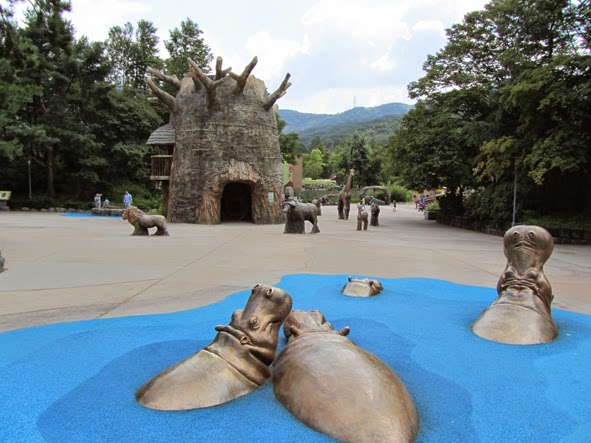
There
is even a plaza where metal hippos appear to be sticking their heads out of a
blue gravel pond.
The Tigers
Since
the amount of time allotted to explore this zoo was short, I decided to concentrate
on at least getting some decent photographs and video of the Amur tiger (Panthera
tigris altaica) enclosures. At the “Beast
Pavilion”, there were two open-air enclosures housing two tigers each. These enclosures were separated from visitors
by a deep concrete dry moat.
At
2:30pm., the tigers were fed some chicken.
Explanation
sign for tiger enclosure: other than the name of the animal, everything was
written in Korean.
One
of the open-air enclosures with dry moat.
Below
is a video of this exhibit.
There
were also two large cage-type enclosures.
One housed Amur tigers, one housed white tigers. (Because of the negative aspects and health
risks associated with intentionally inbreeding animals to achieve rare
color-morphs like white tigers, many zoos do not keep white tigers.)
There
was even a food stand decorated in a tiger motif.
Other Exhibits
Entrance to “Ape Pavilion”.
This
exhibit utilized electrified wires and a deep dry moat to keep the animals from
escaping.
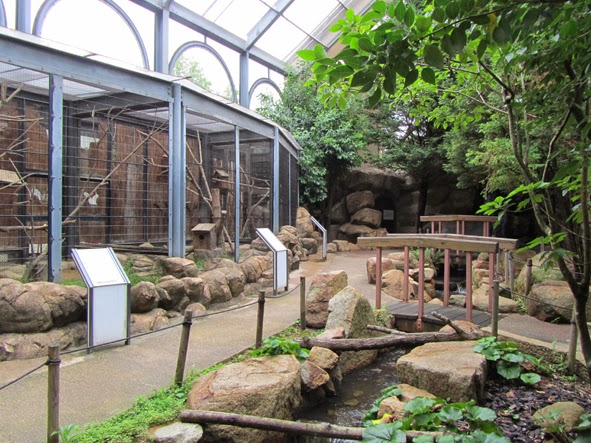
The “Oriental
Pavilion” housed snakes, crocodiles, and monkeys.
“Bear
Pavilion”
Dolphin
show at “Marine Pavilion”.
The
physical size of this zoo was really impressive. Looking at the map I brought home, I realized
that I only managed to walk through about one-third of the property. Without question, this is one zoo that I
would like to someday revisit.
(Note:
All photos taken in this post were taken during a visit on September 10, 2012. The comments in this post are based on
observations made on that day.
Conditions may have since changed.
Please check it out for yourself!)
Without question, the star of Kobe
Oji Zoo in KobeCity,
HyogoPrefecture is Tan Tan the panda. Kobe Oji is one of only three places in Japan (the other two are Ueno Zoo in Tokyo and Adventure World
in Shirahama) where you can see a panda, and the Japanese public loves pandas. A visitor’s entry into panda world starts at
the closest train station, the Hankyu Railways Oji Kouen Station, where cute
panda characters skip along the walls and down the stairs.
(Photo:
January 2013)
Immediately
after exiting the station, giant pandas on the railway track pillars point the
way to the zoo.
(Photo:
August 2014)
While
walking the 100 meters or so to the zoo entrance, one will even find a panda manhole
cover.
(Photo:
January 2013)
The
entrance of the zoo is decorated with a giant panda. Admission for adults is 600 yen. Students up until intermediate school, HyogoPrefecture
residents over the age of 65, and persons who hold a disability certificate,
get in free.
(Photo:
August 2014)
Inside
the zoo, one meets even more pandas.
(Photo:
January 2010)
At
Kobe Oji, Tan Tan the panda (Ailuropoda melanoleuca) is literally the center of
the collection. The panda exhibit is
located almost at the exact center of the zoo grounds. Indicative of how the zoo anticipated large
crowds, the area in front of the panda exhibit has fixed poles and ropes
installed to guide and control long snaking lines of visitors. (Even after seven visits to Kobe Oji, I have yet
to see the waiting lines extend into the second row.)
(Photo:
January 2013)
The
outside portion of the panda exhibit.
(Photo:
August 2014)
On
days of nice weather, Tan Tan may be seen here catching some sun …
(Photo:
January 2014)
…or
eating a bamboo lunch.
(Photo:
January 2014)
The
indoor panda enclosure.
(Photo:
August 2014)
Tan
Tan eating bamboo indoors.
(Photo:
August 2010)
The “Lesser” Panda
In
Japan,
Red Pandas (Ailurus fulgens styani) are called “Lesser Pandas”, and they are so
popular that it seems almost every Japanese zoo has them. Here at Kobe Oji, if the Giant Panda is the
star of the show, the Red Pandas are a strong second. They are small and extremely cute.
(Photo:
January 2010)
Red
Panda exhibit: nicely decorated with plants, but quite small in terms of area –
perhaps too small.
(Photo:
March 2010)
The Koala House
The
third charismatic cutie at Kobe Oji is the koala. KobeCity received its koalas as a gift from Brisbane, its sister-city in Australia.
The koala house.
(Photo:
August 2014)
The
interior of the koala house features a number of “trees” in a room that has a
floor of what looks to be sand or coarse soil.
The koalas spend most of their time in these “trees” sitting (or
sleeping) amid clusters of fresh cut eucalyptus branches and leaves.
(Photo:
August 2014)
A rare
occasion when a koala was spotted sitting on the ground.
(Photo:
January 2010)
Squirrel and SmallBirdForest
One
of the more interesting installations at Kobe Oji is the squirrel and small
bird forest building. To enter the structure, visitors must first pass through
a door into a holding entry area and then again pass through a curtain made of
plastic chains. This double barrier
system is designed to keep the freely roaming birds and chipmunks from escaping.
(Some animals are in enclosures, some roam freely within the enclosure.)
(Photo:
August 2014)
Interior
of squirrel and small bird forest: enclosed displays of squirrels and birds are
on the left.
(Photo:
August 2014)
Squirrel
exhibit with glass walls.
(Photo:
August 2014)
Interior
of squirrel and small bird forest: lots of plants.
(Photo:
August 2014)
A
small house meant for use by either squirrels or birds.
(Photo:
August 2014)
A
freely roaming chipmunk.
(Photo:
January 2013)
The
installation also includes a fishpond stocked with decorative koi.
(Photo:
August 2014)
Big Cat House
The
installation for the big cats is home to five types of Panthera: Amur tigers
(Panthera tigris altaica), Lions (Panthera leo), Jaguars (Panthera onca), Snow
Leopards (Panthera uncial), and Amur leopards (Panthera pardus orientalis). The exhibits seem to be designed more with
zoo visitors in mind than the resident animals.
They have large glass windows that provide visitors a good view of a
sparsely decorated interior, and the overall area of each cat’s area is quite
small. As a result, the cats don’t have
much roaming space, and they also don’t really have anywhere to take a break
and hide from the stares of the constant stream of visitors.
(Photo:
January 2013)
“Yama”,
born May 21, 2000 at the Asa Zoo in Hiroshima.
(Photo:
January 2013)
Because
of the large glass windows used in these exhibits, visitors can get a very up-close
look at the big cats.
(Photo:
January 2014)
The
below video of the tiger exhibit was recorded in 2013.
Lion
(Photo:
January 2014)
Snow
Leopard
(Photo:
January 2013)
Other Animals and
Exhibits
If the big cats’ enclosures
seem to be designed more for the humans than for the animals, the recently
renovated bear exhibits don’t appear to have been successfully designed for
either human or animal.
(Photo:
August 2014)
The
windows for each bear’s enclosure is not particularly wide (for that matter,
each enclosure in general is not particularly wide), and only four or five
visitors at a time can comfortably view the exhibit at one time. If you happen to be the type of bear fan that
likes to park yourself in front of the exhibit and leisurely observe the
animals, you will most certainly get some disapproving looks from other zoo
visitors. There are also some windows
that have been constructed close to the ground, too low for an adult to
comfortably use. Perhaps these were
intended to give small children a unique vantage point, but the children I
observed tended to gravitate to the large windows to stand next to their
parents.
(Photo: January 2014)
(Photo:
January 2013)
The
space allotted to each bear features a simulated rock and river
environment. There is a lot of running
water, but the space is not very large and there are no plants. I couldn’t help thinking that the interiors
of these exhibits somewhat resembled outdoor “onsen”, those meticulously constructed
hot spring baths that are so popular throughout Japan.
(Photo:
January 2013)
The
giraffe exhibit features a raised platform and a window located at the giraffes’
head level. The zoo keepers hang
branches with leaves in front of the window, and if your timing is good, you
can get an up-close view of how the giraffes use their long tongues to eat.
(Photo:
January 2013)
The
polar bear exhibit.
(Photo:
August 2014)
Penguins
at feeding time.
(Photo:
August 2014)
The
chimpanzee exhibit.
(Photo:
August 2014)
The
Asian elephant exhibit.
(Photo:
August 2014)
(Photo:
January 2014)
Educational Efforts
Kobe
Oji has an impressive zoological science center with a large document section.
(Photo:
August 2014)
There
is a museum-class exhibit section with explanations of various animals’ natural
living environments, their usual diets, and unique characteristics.
(Photo:
August 2014)
Part
of the zoological science center is used for temporary exhibits. The below photo is of stuffed specimens; tigers
that previously lived at Kobe Oji. This particular
exhibit was displayed during the year of the tiger.
(Photo:
March 2010)
Opportunities for
Animal Encounters
The
“Children’s World” area of the zoo features domestic farm animals such as
goats, ducks, chickens, and rabbits.
(Photo:
January 2013)
The
below photo shows visitors waiting in line to spend a few minutes with a rabbit
or guinea pig. The animals are placed in
shoe box-sized containers and placed on the visitors’ laps. As far as I could tell, there were no fees to
participate in this particular activity.
(I did not, so I can’t say for sure.)
(Photo:
January 2013)
Food and Souvenirs
Kobe
Oji has two restaurants and a number of outside food stands.
(Photo:
August 2014)
There
are two gift shops with a good selection of items such as animal figures, plush
toys, keyholders, postcards, sweets and cookies...