Showing posts with label Amur tigers. Show all posts

Saturday, January 9, 2016

New Year’s Day 2016 at Tennoji Zoo


For the second year in a row, I celebrated New Year’s Day at Tennoji Zoo in Osaka.  In late 2014, the zoo announced that it would open on January 1, 2015 in observation of its 100th anniversary.  Apparently, the event must have been successful, because they decided to stage a repeat on January 1, 2016. (In past years, the zoo was closed from December 29th to January 1st in observance of the New Year’s holiday.)


This year, the decorations at the Shinsekai entrance included greetings in a number of different languages - an apparent recognition of the fact that the number of foreign tourists visiting Japan has greatly increased in recent years.  Walking around the zoo, my impression was that there were fewer special events than last year, but there seemed to be more visitors this year.  One event that was repeated was the give-away of free commemorative calendars to the first 1000 visitors through the gate. 

One year ago, one of the crowd stoppers was the pair of young Jaguars (Panthera onca) that were born August 9, 2014.  Last New Year’s Day, they were still very small and very cute.


One year later, they were almost as large as their mother, and the female cub was even moved into a separate exhibit space next door.  (I think there was a leopard in that space last year.)


The larger size of the growing cubs made the small size of their enclosures even more obvious. 

This year, another crowd pleaser was the rock hyraxes.  There were five of them, and they were actively eating.  The last time I visited Tennoji Zoo in August, I only noticed two hyraxes, and they were sleeping. 


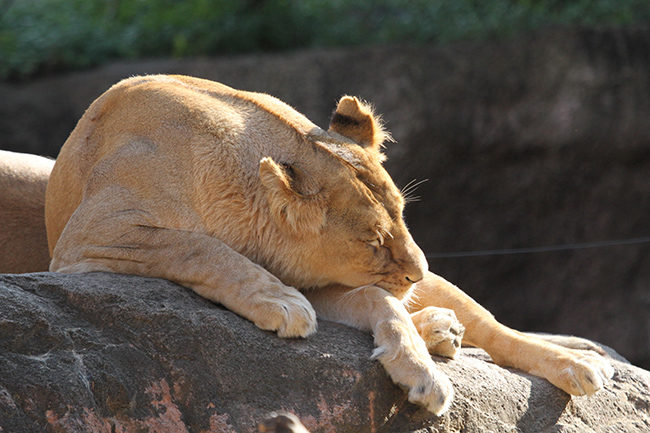
The lions next door also attracted a crowd.


Very majestic…


Another change since last year involved the tigers.  The female tiger Ayako passed away last July 5 at the age of 18 years (quite an advanced age for a tiger).  The very next day, her partner Senichi (12 years old) was moved from the old tiger enclosure to the new tiger enclosure.  Now the two males, Senichi and Kojiro are displayed in rotation in the new tiger enclosure.  Last New Year’s Day, Kojiro was on display in the new enclosure while Senichi and Ayako were still in the old enclosure.  This year, Senichi enjoyed the run of the new enclosure. Somehow, I think he looked more natural in the old place. The old tiger enclosure had more greenery.  In the new tiger enclosure, the concrete walls dominate the scene a little too much.


Senichi close-up


On this day, the younger tiger Kojiro, was confined to the small indoor exhibit.  He seemed to be quite relaxed.


I wonder if the zoo will be open for New Year’s Day 2017.  If it is, I think I will make this visit a yearly tradition.

(Note: All photos taken in this post were taken during a visit on January 1, 2016.  The comments in this post are based on observations made on that day.  Conditions may have since changed.  Please check it out for yourself!)


Saturday, September 13, 2014

Seoul Zoo (Gwacheon, Republic of Korea)


In September 2012, I had the opportunity to visit Seoul Zoo which is located at the border of the Seoul and Gwacheon Districts in the Republic of Korea.  Since I was preoccupied with chaperoning a group of students, and because we did not allot enough time to adequately explore what turned out to be a very expansive zoo, I didn’t take as many photographs of the animals as I normally would.

A Really “Grand” Park
Seoul Zoo is located within the Seoul Grand Park. To get there, you ride the subway 11 stops from Seoul Station (about 20 to 25 minutes) to “Seoul Grand Park” station. The park grounds are very, very, large. After exiting the subway station, it is about a 500-meter walk past the parking lots to a large building where you can purchase a ticket to ride an electric tram another kilometer or so through the park to the actual zoo entrance.  You could choose to walk, but because the zoo itself will also require a lot of walking, I recommend the tram.


If I recall correctly, the ticket for the tram was 800 Korean won.  Admission to the zoo itself was 3000 won.


There was a large tiger statue near the zoo entrance.


The zoo grounds are so wide-spread that they have shuttle trams on routes circling the inside of the property.


There is also a chairlift that travels the full length of the zoo, exits the zoo, and returns back to the area where you first boarded the trams.  Riding this lift will add a little thrill to your visit as there are a few worrisome stretches where it takes you over heavy vegetation in the zoo and over a lake in the park.  If you drop your cellular phone or any other possession, you will have to consider it lost for good.


Gardens of Art
The grounds feature many carefully maintained plants and shrubbery and a number of animal-related artworks.


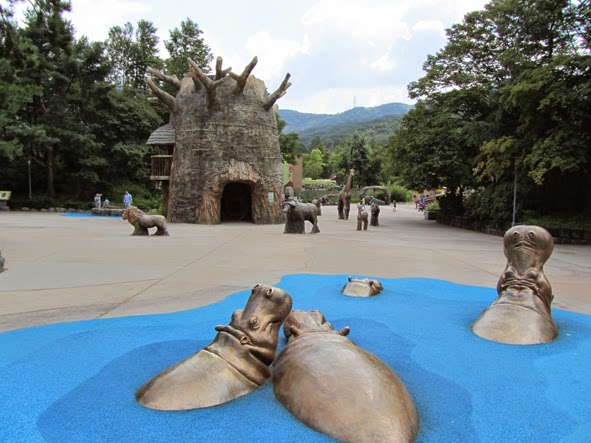
There is even a plaza where metal hippos appear to be sticking their heads out of a blue gravel pond.


The Tigers
Since the amount of time allotted to explore this zoo was short, I decided to concentrate on at least getting some decent photographs and video of the Amur tiger (Panthera tigris altaica) enclosures.  At the “Beast Pavilion”, there were two open-air enclosures housing two tigers each.  These enclosures were separated from visitors by a deep concrete dry moat.


At 2:30pm., the tigers were fed some chicken.


Explanation sign for tiger enclosure: other than the name of the animal, everything was written in Korean.


One of the open-air enclosures with dry moat.


Below is a video of this exhibit.


There were also two large cage-type enclosures.  One housed Amur tigers, one housed white tigers.  (Because of the negative aspects and health risks associated with intentionally inbreeding animals to achieve rare color-morphs like white tigers, many zoos do not keep white tigers.)


There was even a food stand decorated in a tiger motif.


Other Exhibits
Entrance to “Ape Pavilion”. 


This exhibit utilized electrified wires and a deep dry moat to keep the animals from escaping.


The “Oriental Pavilion” housed snakes, crocodiles, and monkeys.


“Bear Pavilion”


Dolphin show at “Marine Pavilion”.


The physical size of this zoo was really impressive.  Looking at the map I brought home, I realized that I only managed to walk through about one-third of the property.  Without question, this is one zoo that I would like to someday revisit. 

(Note: All photos taken in this post were taken during a visit on September 10, 2012.  The comments in this post are based on observations made on that day.  Conditions may have since changed.  Please check it out for yourself!)