Showing posts with label Osaka zoo. Show all posts

Saturday, January 9, 2016

New Year’s Day 2016 at Tennoji Zoo


For the second year in a row, I celebrated New Year’s Day at Tennoji Zoo in Osaka.  In late 2014, the zoo announced that it would open on January 1, 2015 in observation of its 100th anniversary.  Apparently, the event must have been successful, because they decided to stage a repeat on January 1, 2016. (In past years, the zoo was closed from December 29th to January 1st in observance of the New Year’s holiday.)


This year, the decorations at the Shinsekai entrance included greetings in a number of different languages - an apparent recognition of the fact that the number of foreign tourists visiting Japan has greatly increased in recent years.  Walking around the zoo, my impression was that there were fewer special events than last year, but there seemed to be more visitors this year.  One event that was repeated was the give-away of free commemorative calendars to the first 1000 visitors through the gate. 

One year ago, one of the crowd stoppers was the pair of young Jaguars (Panthera onca) that were born August 9, 2014.  Last New Year’s Day, they were still very small and very cute.


One year later, they were almost as large as their mother, and the female cub was even moved into a separate exhibit space next door.  (I think there was a leopard in that space last year.)


The larger size of the growing cubs made the small size of their enclosures even more obvious. 

This year, another crowd pleaser was the rock hyraxes.  There were five of them, and they were actively eating.  The last time I visited Tennoji Zoo in August, I only noticed two hyraxes, and they were sleeping. 


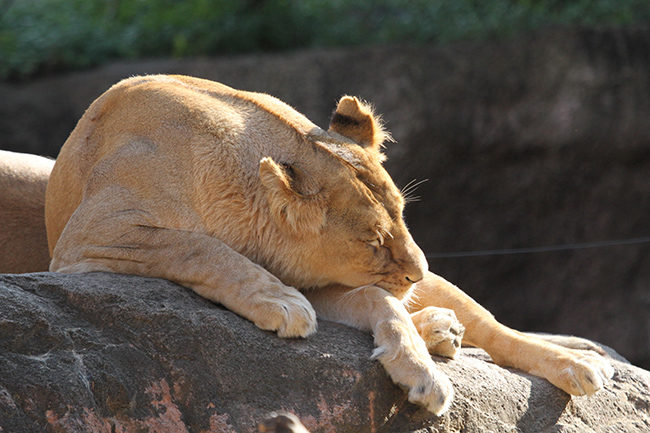
The lions next door also attracted a crowd.


Very majestic…


Another change since last year involved the tigers.  The female tiger Ayako passed away last July 5 at the age of 18 years (quite an advanced age for a tiger).  The very next day, her partner Senichi (12 years old) was moved from the old tiger enclosure to the new tiger enclosure.  Now the two males, Senichi and Kojiro are displayed in rotation in the new tiger enclosure.  Last New Year’s Day, Kojiro was on display in the new enclosure while Senichi and Ayako were still in the old enclosure.  This year, Senichi enjoyed the run of the new enclosure. Somehow, I think he looked more natural in the old place. The old tiger enclosure had more greenery.  In the new tiger enclosure, the concrete walls dominate the scene a little too much.


Senichi close-up


On this day, the younger tiger Kojiro, was confined to the small indoor exhibit.  He seemed to be quite relaxed.


I wonder if the zoo will be open for New Year’s Day 2017.  If it is, I think I will make this visit a yearly tradition.

(Note: All photos taken in this post were taken during a visit on January 1, 2016.  The comments in this post are based on observations made on that day.  Conditions may have since changed.  Please check it out for yourself!)


Saturday, January 10, 2015

New Year’s Day 2015 at Tennoji Zoo


New Year’s Day might be an unusual day to go to a zoo, but since Tennoji Zoo in Osaka announced it would be open on January 1st to start the celebrations of its 100th anniversary, I thought I would go to see how the animals greeted the start of 2015.  (In usual years, the zoo is closed from December 29th to January 1st in observance of the New Year’s holiday.)


Predictably, there were congratulatory decorations, signs, banners, and a few commemorative goods for sale.  There were also a number of special events, and even free commemorative calendars for the first 1000 visitors through the gate. 

Despite the very cold temperature, there were a surprising good number of visitors in the zoo.  One of the crowd stoppers was the pair of young Jaguars (Panthera onca) that were born last August 9th


The window of the exhibit was a bit dirty, so it was impossible to get a sharply focused photograph of the baby Jaguars.


Even if the photo isn’t sharp, they’re still very cute.


If only the exhibit was larger… and nicer… and had more natural elements…


Perhaps the biggest crowd of the day was the approximately 150 people gathered to watch ten visitors play a game of “tug-of-war” against Kojiro, the young male Amur tiger (Panthera tigris altaica).


They tied one end of the rope to a large bone that still had some meat on it.


When Kojiro grabbed the bone, the participants pulled on the rope - not with all their might, but with just enough resistance to give Kojiro some exercise.


There were a lot of video cameramen and photographers.  I think they were from the television stations and newspapers.  At least two of the video cameramen had armbands with the “NHK” television logo on it.


After about 10 minutes, Kojiro was allowed to enjoy his afternoon snack.


(Note: All photos taken in this post were taken during a visit on January 1, 2015.  The comments in this post are based on observations made on that day.  Conditions may have since changed.  Please check it out for yourself!)


Wednesday, June 25, 2014

Dwarf Mongooses


When I go to Tennoji Zoo in Osaka, I always make time to visit the dwarf mongoose enclosure.  Dwarf mongooses (Helogale parvula) are originally from parts of east and southern Africa.  They average about 18 to 28 centimeters in length and about 200 to 350 grams in weight.  They are small and irresistibly cute.  


Dwarf mongoose enclosure at Tennoji Zoo. (Photo taken April 2012).

In the wild, they often make their homes in termite mounds, and their display at Tennoji Zoo includes replica termite mounds, complete with a fake lizard. 


According to the IUCN Red List of Threatened Species, a 2008 assessment of dwarf mongooses gave them the status of “Least Concern”.  It’s nice to know that they are not an endangered species.


On one of my visits, I was lucky enough to arrive just at feeding time.  A zookeeper entered the enclosure with a bamboo tube that had holes drilled into it like a flute.  The bamboo tube was full of some kind of mealworm or insect larvae, and when the dwarf mongooses saw it, they all came scurrying out of their holes.


It was fascinating to watch the dwarf mongooses scratch and sniff at the tube.


I guess even dwarf mongooses have to work for their dinners.


Gotcha!

The video below of grooming dwarf mongooses was recorded on April 15, 2012.


Unless otherwise noted, all photos in this posting were taken in January 2012.


Cute.   Very cute!