Saturday, January 16, 2016

Kobe Oji Zoo’s Cute Red Panda


With the start of the New Year, I decided to see what was new at Kobe Oji Zoo in Kobe City.

First of all, the Waterfowl exhibit had a new walk-in area for visitors – it was quite an improvement. In the past, visitors had to view the animals through the netting used to keep the captive birds in and the local birds out.  The netting was an obstacle to visibility, and visitors would often walk by without stopping to take a look at the birds.  With the new walk-in terrace, visitors can get a closer, unobstructed view.


View inside the Waterfowl exhibit.


Indian Peafowl (Pavo cristatus)


Mandarin Duck (Aix galericulata)


I also visited the Koala House.


Umi, a female Koala (Phascolarctos cinereus) born in June 2014 was awake and eating.  And while she doesn’t really qualify as something “new”, the Koalas are usually sleeping when I visit, so I am including a photo.


Next to the Koala House was the enclosure for the Red Pandas (Ailurus fulgens styani), usually referred to as “Lesser Pandas” in Japan.


The young female Tiara, born July 6, 2015, was roaming the exhibit with her mother Minfa.  She was extremely cute and a great crowd pleaser.  I took quite a number of photographs and am including a small album here.


Finally, I also made sure to stop in on an old friend - “Yama”, the female Amur Tiger (Panthera tigris altaica).  Yama was born May 21, 2000 at the Asa Zoo in Hiroshima, and is now 15 years old – which is older than most tigers in the wild manage to survive.  Despite her advanced age, she still has a very regal presence.  Long live the Queen!


(Note: All photos taken in this post were taken during a visit on January 4, 2016.  The comments in this post are based on observations made on that day.  Conditions may have since changed.  Please check it out for yourself!)


Saturday, January 9, 2016

New Year’s Day 2016 at Tennoji Zoo


For the second year in a row, I celebrated New Year’s Day at Tennoji Zoo in Osaka.  In late 2014, the zoo announced that it would open on January 1, 2015 in observation of its 100th anniversary.  Apparently, the event must have been successful, because they decided to stage a repeat on January 1, 2016. (In past years, the zoo was closed from December 29th to January 1st in observance of the New Year’s holiday.)


This year, the decorations at the Shinsekai entrance included greetings in a number of different languages - an apparent recognition of the fact that the number of foreign tourists visiting Japan has greatly increased in recent years.  Walking around the zoo, my impression was that there were fewer special events than last year, but there seemed to be more visitors this year.  One event that was repeated was the give-away of free commemorative calendars to the first 1000 visitors through the gate. 

One year ago, one of the crowd stoppers was the pair of young Jaguars (Panthera onca) that were born August 9, 2014.  Last New Year’s Day, they were still very small and very cute.


One year later, they were almost as large as their mother, and the female cub was even moved into a separate exhibit space next door.  (I think there was a leopard in that space last year.)


The larger size of the growing cubs made the small size of their enclosures even more obvious. 

This year, another crowd pleaser was the rock hyraxes.  There were five of them, and they were actively eating.  The last time I visited Tennoji Zoo in August, I only noticed two hyraxes, and they were sleeping. 


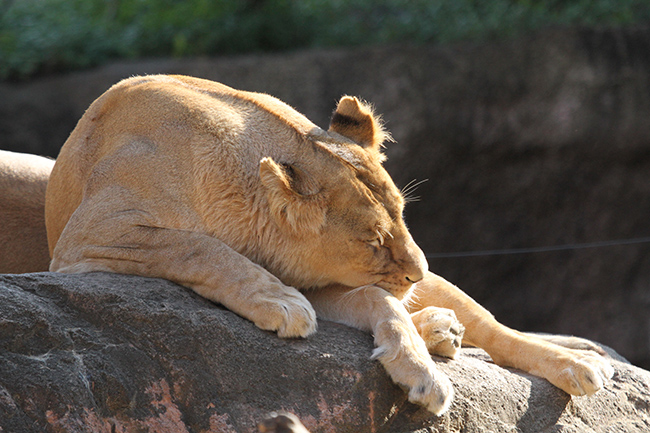
The lions next door also attracted a crowd.


Very majestic…


Another change since last year involved the tigers.  The female tiger Ayako passed away last July 5 at the age of 18 years (quite an advanced age for a tiger).  The very next day, her partner Senichi (12 years old) was moved from the old tiger enclosure to the new tiger enclosure.  Now the two males, Senichi and Kojiro are displayed in rotation in the new tiger enclosure.  Last New Year’s Day, Kojiro was on display in the new enclosure while Senichi and Ayako were still in the old enclosure.  This year, Senichi enjoyed the run of the new enclosure. Somehow, I think he looked more natural in the old place. The old tiger enclosure had more greenery.  In the new tiger enclosure, the concrete walls dominate the scene a little too much.


Senichi close-up


On this day, the younger tiger Kojiro, was confined to the small indoor exhibit.  He seemed to be quite relaxed.


I wonder if the zoo will be open for New Year’s Day 2017.  If it is, I think I will make this visit a yearly tradition.

(Note: All photos taken in this post were taken during a visit on January 1, 2016.  The comments in this post are based on observations made on that day.  Conditions may have since changed.  Please check it out for yourself!)


Saturday, December 12, 2015

A Zoo in a Shopping Mall?


“A zoo in a SHOPPING MALL?”  I knew that Japan was home to many quirky animal attractions like cat cafes and owl cafes, but when I heard about this particular collection, I immediately knew that I had to see it with my own eyes.  The name of this place is “Meccha sawareru doubutsuen” which basically means “zoo where you can touch a lot”, and it is located in the Pieri Moriyama shopping mall in Moriyama City, Shiga Prefecture.

It really is located in a shopping mall.


The collection occupies about the same amount of floor space as a medium-sized restaurant or clothing store, and true to its name, this animal collection allows visitors a great deal of physical contact with many of the resident animals.  And although the animal species in this collection might have been chosen for their tolerance of human contact, the amount of contact that occurs here might very well exceed acceptable limits. 

The entrance looked similar to a typical pet shop.  There was a dwarf rabbit and various types of beetles for sale. 


The area immediately inside the entrance was crowded with dogs, rabbits, chicks, turtles, caged birds and even a small monkey.  Most of the “exhibits” were built to allow small children unfettered access to the animals. Predictably, small children end up handling the animals extensively – sometimes like toys.  I observed one little girl trying to see how many chicks she could carry at one time.


There were a number of birds and small animals in small cages.


The amount of space allowed to this goat was about equal to a king-sized bed.


The monkey constrained to this small cage was enough to tear at one’s heartstrings…


…especially when he tried to tear at my camera strap.


Proceeding to the inner part of the “zoo”, the area was decorated to resemble a jungle.


There was a Canadian wildcat.


This alligator had a small pool to himself.


The room below was about 4 meters long by about 3 meters wide and about 3 meters high.


It housed a young lion.


This 50-centimeter wide glass corridor allowed visitors to get very close to the lion.


Next to the lion, there was a Shoe-billed stork.  It stood so still that some visitors at first thought it to be a statue.


There were many animals in glass tanks.


Snakes


Turtles


Fish


Armadillo


Hedgehogs


There was a line-up of birds along a wooden wall.


Ropes attached to their legs kept them restrained to their wooden perches.


Other animals restrained by leashes: owl


Meerkat


Squirrel monkey


Sign warning that the squirrel monkey might bite.


The Freemovers
Some animals were not restrained, and I was amazed that they did not try to run away.  Perhaps they simply did not know in which direction they should run.


Bat


This wallaby hopped from area to area, doing its best to avoid humans.


Mara (Patagonian Cavy)


For me, visiting this collection turned out to be a strange experience.  Forget about immersion exhibits resembling natural habitats – entering this “zoo” was an immersion of a different kind.  So many visitors and so many animals crammed into such close quarters.  Petting zoo?  Pet shop?  I still don’t know how to best describe or classify this bizarre collection.

Admission for adults was 1000 yen.  Admission for children from 3 years old up to intermediate school was 600 yen.  Children 0, 1, and 2 years old were admitted free. 

(Note: All photos taken in this post were taken during a visit on August 17, 2015.  The comments in this post are based on observations made on that day.  Conditions may have since changed.)


...............................................................................................................................................

UPDATE: This facility closed on January 15, 2019

The shopping mall management apparently decided to end the contract for the space which the zoo occupied.  It is notable that there were considerable complaints about the facility from groups concerned about animal welfare.  Some of these concerns were detailed in a June 4, 2017 online news article (Huffpost Japan edition) which referenced an open wound on the head of the lion.